Forex affiliate marketing guide
Forex affiliate marketing is a performance-based arrangement where an individual or business earns a commission by referring new clients to a forex broker or trading platform. When a referred user opens an account and begins trading, the affiliate receives payment — either as a flat fee, a share of the broker's revenue, or a combination of both.
The model borrows from broader digital affiliate marketing but carries industry-specific characteristics that matter. Forex is a leveraged, regulated market. That context shapes what affiliates can say, how brokers structure their programs, and what compliance requirements apply from the outset.
Affiliates are not introducing brokers, though the two are often confused. An introducing broker typically holds a regulatory registration and takes on a more formal relationship with the brokerage. An affiliate operates at arm's length — producing content, running paid traffic, or managing communities that direct prospective traders toward a broker's sign-up page.
The earning potential is real, and the barrier to entry is relatively low. But the forex affiliate space rewards those who understand the product they are promoting. Recommending a broker without understanding spreads, execution quality, or regulatory standing tends to produce low conversion rates and, in regulated jurisdictions, potential legal exposure.
How the forex affiliate model works
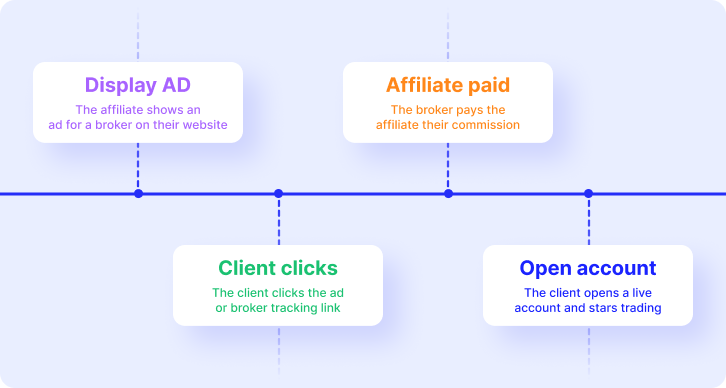
The mechanics are straightforward. An affiliate joins a broker's partner program and receives a unique tracking link. That link is embedded in their content — articles, comparison pages, YouTube descriptions, or email sequences. When a visitor clicks the link, a cookie is placed on their browser. If that visitor completes a registration and meets the broker's qualifying criteria, the affiliate's account is credited.
What varies significantly between programs is the qualifying threshold. Some brokers trigger a commission on account registration alone. Others require a minimum deposit, a minimum number of executed trades, or both. Reading the program terms carefully is not optional — it directly determines whether the traffic an affiliate drives actually converts into earnings.
Tracking is typically handled through a dedicated affiliate dashboard, which logs clicks, registrations, and commission status in real time. Most major brokers use established affiliate tracking platforms to manage this. Discrepancies between reported clicks and confirmed conversions are common, and understanding attribution windows — usually 30 to 90 days — helps affiliates diagnose where referrals are dropping off.
Cookie duration matters more than many new affiliates realise. A 30-day window means that if a referred visitor signs up 31 days after clicking the link, the commission is forfeited. Some brokers offer lifetime attribution, which meaningfully changes the long-term value calculation.
Types of affiliate programs in forex
Not all forex affiliate programs are structured the same way, and the differences go beyond commission rates. The type of program an affiliate joins will shape their earning model, their relationship with the broker, and the kind of audience they need to build.
The most common structure is the standard CPA program, where the affiliate earns a fixed payment per qualified referral. CPA stands for cost per acquisition. The broker defines what acquisition means — typically a verified account with a minimum deposit. Payments can range from under $100 to several hundred dollars per referral, depending on the broker and the quality of the traffic the affiliate delivers.
Revenue share programs work differently. Instead of a flat fee, the affiliate receives a percentage of the spread or commission the broker earns from the referred client's trades. This model pays out over time rather than upfront, which means low initial returns but compounding value if referred clients remain active.
Hybrid programs combine both. An affiliate receives a reduced CPA payment on qualification, then a smaller ongoing revenue share for as long as the client trades. These tend to appeal to affiliates with established, engaged audiences rather than high-volume traffic sources.
Sub-affiliate programs exist within some larger networks, allowing affiliates to earn a percentage of commissions generated by affiliates they have referred into the program. The structure adds a layer of leverage but also dilutes focus if not managed carefully.
Key metrics: CPA, Revenue Share, and Hybrid Models
Understanding the three core commission structures is one thing. Knowing how to evaluate them against each other requires working through the numbers, not just the labels.
CPA is the simplest to model. If a broker pays $300 per qualified deposit and an affiliate converts 20 referrals per month, gross monthly earnings are $6,000. The calculation is linear. But CPA income stops when referrals stop, which makes it heavily dependent on consistent traffic generation.
Revenue share demands a longer time horizon. A broker might offer 20% of the net spread revenue generated by a referred client. If that client trades a standard lot of EUR/USD with a 1-pip spread, the broker earns roughly $10 per round turn. The affiliate receives $2. A single active client trading 50 lots per month generates $100 in monthly revenue share. Scale that across 100 active clients and the compounding becomes meaningful — but it takes time and requires referred clients who actually trade.
Hybrid models reduce upfront risk for the broker while offering the affiliate a blended income stream. The CPA component is usually 30 to 50 percent lower than a pure CPA rate, offset by the revenue tail. Which structure performs better depends entirely on client lifetime value — a metric brokers hold closely and affiliates rarely have direct access to.
Choosing the right forex broker to promote
The broker an affiliate chooses to promote reflects directly on their reputation. That is not a minor consideration. Recommending a poorly regulated or operationally unreliable broker to an audience damages trust in ways that take years to recover, if at all.
Regulatory standing is the first filter. Brokers regulated by Tier-1 authorities — the FCA in the UK, ASIC in Australia, the CFTC and NFA in the United States, or CySEC within the EU — operate under meaningful capital and conduct requirements. Offshore-regulated brokers may offer higher CPA rates, but the increased risk of client complaints, withdrawal issues, or regulatory action creates liability for anyone who has publicly recommended them.
Execution quality and trading conditions matter because they affect whether referred clients remain active traders. A broker with wide spreads, frequent requotes, or poor platform stability will generate short client lifetimes. That is a direct earnings problem for revenue share affiliates and a reputational problem for all.
Affiliates should also review the broker's track record with partner payments. Late payments, altered attribution rules, or abruptly lowered commission rates are documented grievances across forex affiliate communities. Checking independent broker reviews and verified partner feedback before committing is standard due diligence.

Compliance, regulation, and disclosure requirements
Forex affiliate marketing operates inside a regulated industry, and affiliates are not exempt from the rules that govern financial promotion. The specific requirements vary by jurisdiction, but the core principle is consistent: material promoting a forex broker must be fair, clear, and not misleading.
In the UK, the FCA requires that financial promotions be approved by an authorised person before distribution. For affiliates, this typically means that broker-provided marketing materials must carry the broker's compliance approval, and any independently produced content — reviews, comparison articles, social content — must meet the same standard. Risk warnings are not optional decoration. They are a legal requirement in most regulated markets, and their placement and prominence are specified.
The United States adds a further layer. The CFTC and NFA impose strict rules on forex advertising and the representation of trading results. Affiliates distributing content to US-based audiences, or promoting brokers soliciting US clients, need to understand those boundaries carefully.
Disclosure of the commercial relationship is a baseline expectation in most jurisdictions and increasingly enforced. An affiliate who earns a commission for recommending a broker is expected to say so. Readers have a right to know when a recommendation carries a financial interest.
Building and growing an audience
Commission rates are largely irrelevant without an audience positioned to act on the content being produced. And in forex affiliate marketing, audience quality consistently outperforms audience size.
The most durable traffic sources in this space are organic search and email. Content that ranks for commercially relevant forex queries — broker comparisons, platform reviews, strategy guides — generates referred traffic without ongoing paid acquisition costs. That requires producing content with genuine informational value rather than thin promotional pages built around affiliate links.
Email lists convert at higher rates than cold traffic because the relationship has been established before the recommendation arrives. Affiliates who capture leads through educational content — guides, free courses, market explainers — and nurture those leads over time generate referrals with significantly higher deposit rates and client lifetimes.
Paid traffic is viable but expensive in the forex niche. Cost-per-click on forex-related keywords is among the highest in digital advertising. Margins only hold if conversion rates and commission values are carefully modelled before spend begins.
YouTube and long-form content platforms are increasingly relevant, particularly for audience segments that prefer video-based learning. Platform tutorials, broker walkthroughs, and strategy explanations generate sustained views and referral clicks over months or years after publication — a different economics from paid acquisition entirely.